| History | Features | Images | Screenshots |
The original compass of the manuals is 56 keys. The same compass is available in the virtual model. The pedal compass is 30 tones.
The samples are offered in 24bit/48kHz quality, multiple releases (3 levels). Plain wave formant (no encryption). The reverberation time is up to 6 seconds for the ambiental version. The sample set is offered in the surround (four channels), in the wet and in the dry variants.
Many ranks of Borstwerk, Rugwerk and Bovenwerk offer recorded tremmed samples
(recorded tremulants). These special tremmed ranks can be identified by the word
"tremmed" in the rank description. Load these special ranks together with the
normal rank to get the correct behavior with the tremulant engaged.
The ranks where no tremulant was recorded, an alternative Hauptwerk tremulant
model is used while processing the left and the right channel independently.
This gives considerably more convincing results than using plain Hauptwerk
tremulant model. Hauptwerk v.4 does not natively support independent left and
right channel treatment. For this reason, you can see the Left and Right
component on certain ranks in the rank loading menu. It is important to load
both the left and the right component of the front ranks into the same audio
stereo output of Hauptwerk (the front or main output) to get the full sound of
the stop. Similarly, it is important to load both the left and the right
component of the rear rank into the same rear audio output. This is done in the
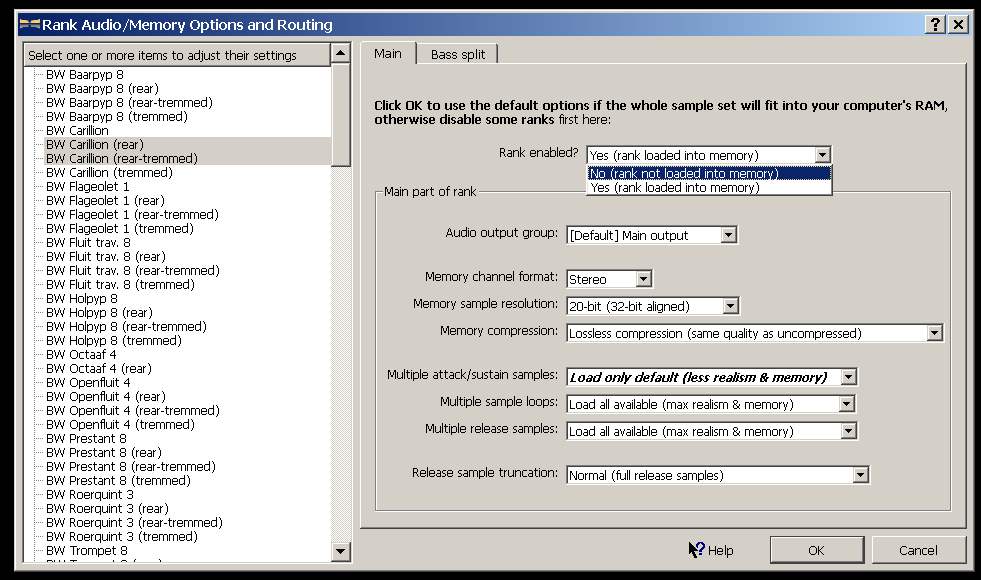
Rank Audio/Memory Options Loading and Routing dialog (when the organ is loaded
for the first time, or when it is loaded via the Load Organ Adjusting Rank Audio
Output menu entry). Please note that the Left and Right componets of a rank are
not mono wave files, but stereo files with the opposite channel muted (since
Hauptwerk does not allow for hard-panning left and right mono wave files). For
this reason, it is essencial that the left and right components are loaded into
the same stereo audio output.
To load on 48GB machines: load everything in 20-bit, while the most used ranks (8-feet principals, flutes and similar) try loading in 24-bit depth.